Before You Call India’s Food Label a 'Health Revolution', First Read the Court Order !
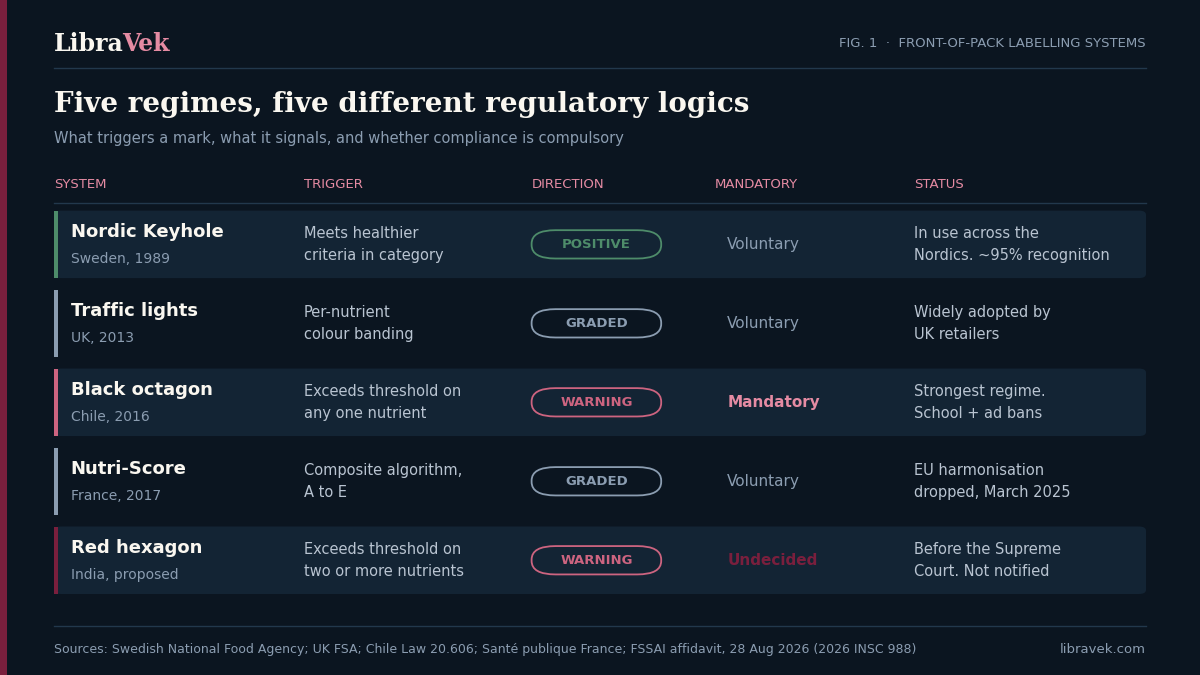
The red hexagon has not been approved, notified, or dated. On 10 September the Supreme Court sent it back to FSSAI with thirteen questions, and Chile already showed us what the answers will decide.
"Health revolution" - that is the phrase that has circulated for two weeks, alongside a picture of a cola bottle with HIGH SUGAR across the front !
I understand the feeling, and I am not going to take it from anyone. The people who got us here pushed for more than a decade against an industry that did not want it. They were right to push.
But Chile did this ten years ago, and the results are worth knowing before we decide what has been won.
What happened when a country actually did it...
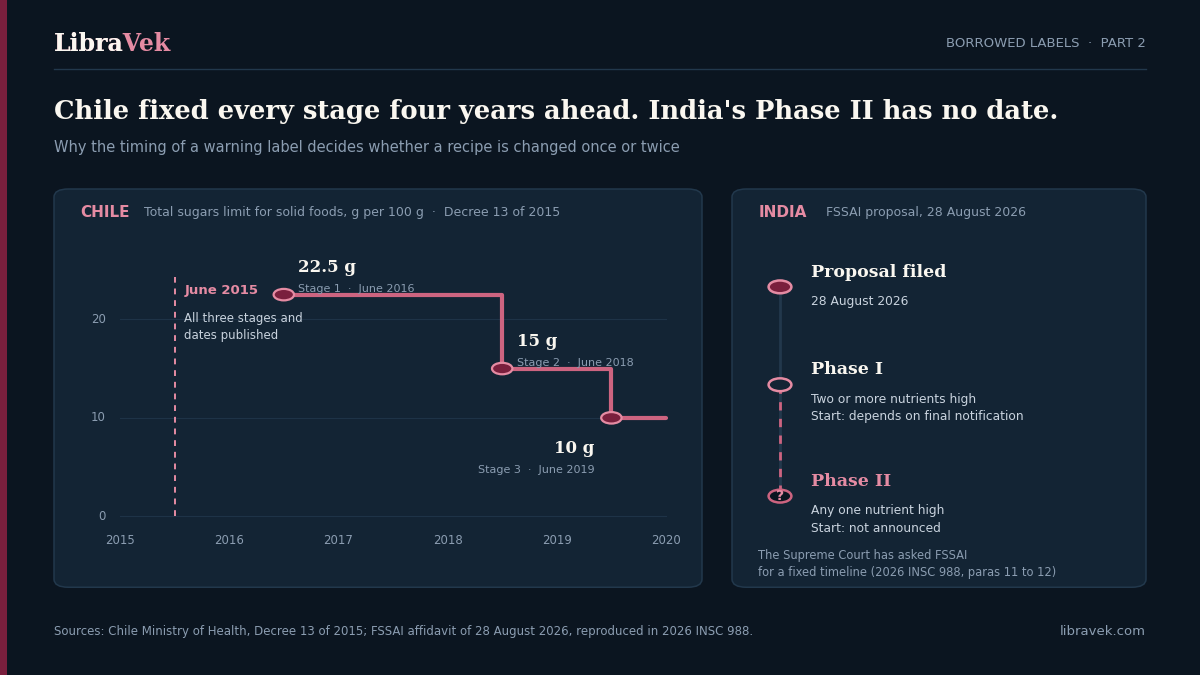
In 2016 Chile introduced mandatory black octagon warnings on packaged food, still the strongest front-of-pack regime anywhere. Products carrying a warning were banned from schools and from advertising to children under fourteen.
Manufacturers responded, and quickly. Evaluations found real reductions in sugar and sodium, and showed that industry can reformulate at speed when the law requires it. That part is a genuine public-health win and I do not want to flatten it.
But the same evaluations found two other things. Products containing non-nutritive sweeteners increased, which suggests manufacturers replaced sugar rather than reduced sweetness. And very few products reduced saturated fat at all.
So on a great many packets, the sugar octagon came off. The sweetness did not go anywhere; it changed its name. And fat, the most expensive thing to fix, was largely left alone.
A label can succeed completely and still leave the food roughly where it was. That is not a cynical reading. It is the measured outcome of the strongest labelling law on earth.
India is not about to implement something stronger than Chile's. It is about to implement something softer. Which makes the question of what replaces the sugar, salt and fat the central question, not a footnote to it.
Remarkably, the Supreme Court has already asked it.
What the Court actually did on 10 September?
It did not approve the red hexagon. That is worth stating plainly, because much of the celebration has run ahead of the record.
In 3S and Our Health Society v. Union of India (2026 INSC 988), Justices J.B. Pardiwala and K. Vinod Chandran acknowledged FSSAI's progress and then took the proposal apart, question by question
Here is how that works, for readers who do not spend their week reading court orders.
FSSAI did not announce its label in a press release. It filed it in a sworn affidavit to the Supreme Court on 28 August, in a case that has been running since 2024. The Court read that affidavit, found several parts of it unclear, and then did something unusual. At the end of its order, in paragraph 53, it wrote out thirteen numbered questions and directed FSSAI to answer every one of them in a further affidavit, within ten days.
These are not remarks or observations. They are formal directions with a deadline. Whatever FSSAI answers goes on the court record, and the Court takes up those answers on 28 September.
The thirteen cover the trigger threshold, how sugar and fat are measured, how the rollout is phased, how ultra-processed foods are treated, the size and colour of the hexagon, and whether the rules will be compulsory from the first day.
Of those thirteen, the eleventh is the one I would read first. It asks what happens to the food itself once manufacturers begin to reformulate.
Question XI: How would the FSSAI regulate the potential increase in the use of artificial preservatives, emulsifiers and similar additives that may follow as a consequence of implementing the warning label?
Paragraph 44 of the order explains why the Court asked this. Salt, sugar and fat are not only nutrients. They are functional ingredients. They give food its taste. They give it texture. They keep it safe to eat and give it a long shelf life. They also affect how it behaves during processing.
So if you take them out, something else has to do that job. That something is usually an additive.
The Court says this directly. It tells FSSAI to keep this risk in mind when it sets the thresholds, and to write rules for these added chemicals as well (para 45).
This is the question I could not answer in my own research. My master’s thesis at the University of Padova was on front-of-pack labelling and consumer perception. I read several hundred papers, looking for one country that had solved this. I did not find one !
Who is actually reading the label?
Before the thresholds, there is a prior question, and it is the one I think about most.
Almost the entire European evidence base for front-of-pack labelling rests on an assumption that is rarely stated aloud. It assumes a supermarket. A person standing in an aisle with three competing products in front of them, with the time to compare and the literacy to do it. Under those conditions the labels work, and the studies show it.
Now picture a kirana shop in small town where blinkit is not accessible unlike metro cities of india. The transaction takes under a minute. You ask; the packet comes from behind a counter or off a strip hanging overhead. Often there is no second brand of that product in the shop at all.
A warning label works by enabling comparison. Where there is nothing to compare against, it becomes information with no decision attached to it.
The Indian survey evidence shows the same gap between what people say and what they do.
What Indian consumers say, and what they do
| Finding | Result | Study |
|---|---|---|
| Knew about food labelling | 95% | Bhattacharya et al., 2022 - 14 states, n=2,024 |
| Preferred warning labels to other formats | 93% | Bhattacharya et al., 2022 |
| Used nutrient composition when buying | 17.7% | Verma et al., 2024 - Pune, n=226 |
| Found the font hard to read | 30.4% | Verma et al., 2024 |
| Never changed a purchase over a label | 59% | Verma et al., 2023- Bathinda, n=722 |
The Court saw this too. FSSAI has proposed a strictly word-based label, and at paragraph 38 the bench objects that a word-based warning presupposes a level of comprehension, literacy and reading capability across regions, vernaculars, age groups and literacy levels that India does not uniformly have. It notes that the normal conditions of purchase in this country do not fit into one homogenous box, and asks why there are no pictorial representations of the individual nutrients.
That is not a design quibble. A label is read by a person. Whether that person can read it is the whole mechanism.
Two decisions that will define what this becomes
The rest of the order turns on measurement, and two findings matter more than the others.
"The two-nutrient trigger"- under the proposal filed on 28 August, Phase I applies only to products high in two or more of added saturated fat, added sugar and salt. A product loaded with sugar but low in salt and fat carries nothing. The petitioner's objection at paragraph 8 is physiological: sugar, salt and saturated fat are independently harmful through different pathways. The Court went further, finding at paragraph 9 that the government's own documents contradict each other, the 2024 Guidelines define HFSS conjunctively, the 2022 Draft Regulations disjunctively, and calling that confusion a priority to resolve. The Additional Solicitor General then told the Court that FSSAI is open to revising the basis for the phases (para 10). Regulators do not say that about positions they intend to defend.
The thresholds themselves come from the ICMR-NIN Dietary Guidelines for Indians, 2024, set out at paragraph 17.
Nutrient-of-concern thresholds, ICMR-NIN 2024
| Per 100 g / 100 ml | Solids | Liquids |
|---|---|---|
| Energy | 250 kcal | 70 kcal |
| Salt | 625 mg | 175 mg |
| Added Sugar | 3g | 2g |
| Added Fat | 4.2 g | 1.5 g |
"Added, or total" - this is the finding that has gone almost unreported, and for anyone reformulating a product it is the most consequential line in the document. The August affidavit measures added sugar and added saturated fat. But at paragraph 34 the Court reproduces the minutes of a stakeholders' meeting held on 29 October 2021, at which the opposite conclusion was reached: after deliberation, consensus was formed on using total sugar, on grounds of health concern, global acceptability and ease of analytical testing. The Court has asked FSSAI whether its position has changed and, if so, how the original concerns are now met (para 35). It has separately asked about trans fat (para 36), which the proposal does not mention at all.
Total versus added is the difference between measuring what is in the food and measuring what somebody chose to put in it. A formulation engineered to clear one does not necessarily clear the other.
Why Europe never agreed, and what that tells India
Running through the celebration is an assumption that India is finally catching up with Europe. That assumption is wrong twice.
Front-of-pack labelling did not begin in France. It began in Sweden in 1989 with the Keyhole, a symbol that endorses the healthier product rather than warning about the worse one, still in use across the Nordics with recognition above 95 per cent. What France introduced in 2017 was Nutri-Score, the first graded interpretive label, "the model" the world copied, and the one it argues about.
And Europe has not resolved it. Front-of-pack labelling remains voluntary at EU level. The Commission's Farm to Fork commitment to a mandatory harmonised scheme was abandoned by March 2025, after sustained opposition led by Italy, which argued the algorithm misjudges extra-virgin olive oil and Parmigiano Reggiano and promoted its own NutrInform Battery instead.
Working in Italy, I have watched that argument at close range, and it is worth being precise about what it was really about. The Italian objection was never primarily scientific. It was about a class of product that is culturally central, economically protected, and cannot be reformulated. Olive oil is fat. That is what olive oil is. No algorithm changes that and no producer can engineer around it.
India has exactly the same structural problem and has answered it the opposite way. The FSSAI affidavit exempts single-ingredient products and products inherently rich in fat, sugar or salt, ghee, edible oil, salt, sugar, jaggery and honey.
Italy fought the label to protect its un-reformulable staples. India wrote them out of the label. Same problem, opposite instrument, and that exemption boundary is where the next argument will happen.
There is a further complication that the packet-by-packet logic of a warning label struggles with. I am a co-author on a study from the TESAF group at Padova, published in Food Frontiers this year, which looked at how Nutri-Score affects Italian consumers' choices when they plan a whole meal rather than compare two products on a shelf. Most labelling research examines choices within a category. People do not eat within a category. They assemble a meal, and when an entire category scores badly they may simply move to a different one rather than choose better inside it. A single hexagon on a single packet says nothing about that.
The lesson Europe offers is not a design. It is a warning about sequencing. A label that is technically elegant but politically unowned does not become mandatory. Nine years of argument produced no harmonised rule. India's Court has, if anything, moved faster than the Commission ever managed, which makes the quality of the answers filed this month unusually important.
What "I" actually "think"......
None of this is an argument against warning labels. I have spent a year on this because I believe it matters, and a label is better than no label.
But a label is an instrument, not a policy. It works when the thresholds are honest, when the design is legible to the person actually holding the packet, and when the regulation behind it keeps moving after the announcement.
On the evidence in the order, the direction of travel is reasonably clear: from two nutrients to one, from added to total, and eventually toward some rule about what replaces what is removed. For anyone making formulation decisions this quarter, that is a more useful forecast than a headline.
And for anyone celebrating, one thing is worth carrying forward. Do not read the absence of a warning as a certificate of health. In Chile the octagon came off products that had not meaningfully improved. A packet can be changed until the label disappears without the food getting better.
That is not a reason to stop celebrating. It is a reason to keep watching after the applause.
Thirteen questions were asked to FSSAI. The answers are due before 28 September. I would read the eleventh one first !
Primary Sources:
3S and Our Health Society v. Union of India, Miscellaneous Application No. 1177 of 2025 in Writ Petition (Civil) No. 437 of 2024, order dated 10 September 2026 (2026 INSC 988), Supreme Court of India. Earlier orders in the same matter: 09.04.2025, 10.02.2026, 04.08.2026, 13.08.2026.
FSSAI compliance affidavit dated 28 August 2026, reproduced at para 3 of the above order. Minutes of the Stakeholders' Meeting on Front-of-Pack Labelling, 29 October 2021, reproduced at para 34.
ICMR-NIN, Dietary Guidelines for Indians (2024), Guideline 15, Tables 15.1 and 15.2.
Swedish National Food Agency, Keyhole symbol (1989). European Commission, Farm to Fork front-of-pack harmonisation, discontinued March 2025. Published evaluations of Chile's Law of Food Labelling and Advertising (2016).
Stiletto A., Cei L., Singh A., Trestini S., "Unpacking the Impact of Nutri-Score on Consumer Choices in Italy: Evidence From a Menu Planning Experiment", Food Frontiers, 28 April 2026, DOI 10.1002/fft2.70288.
Disclaimer: All content on this blog is for general informational and educational purposes only. It does not constitute professional advice. While I strive for accuracy, I make no representations or warranties regarding the completeness or reliability of the information. Any action you take based on this content is strictly at your own risk, and I will not be liable for any losses or damages in connection with the use of this website.
Found this useful? Share it with your network.
Share on LinkedInThis is exactly the work we do.
If something here made you think twice about a label, a claim, or a market you are entering, that is worth a conversation.
Start the conversation