Thinking of switching to recyclable plastic for your food contact material? Wait ! Think, Then decide....
Every food business knows what its packaging is made of. Almost none know what it carried before.
Sustainability is no longer optional. Consumers want it>> Retailers demand it >> Governments are writing it into law. So when a food business decides to move to recyclable or bio-based packaging, it feels like the right move: responsible, forward-thinking, and good for the brand.
But here is the part most suppliers will not tell you: sustainable packaging and safe packaging are not the same thing. The gap between the two is exactly where regulatory risk lives.
The problem hiding inside the label 'eco-friendly'
A major new report from the Food and Agriculture Organisation (FAO, 2026) - Food safety implications of recycled plastics and alternative food contact materials - has put the food industry on notice. Recycled plastics used in food contact materials, meaning the packaging that directly touches your product, can carry chemical contamination from their previous life: pesticides, pharmaceuticals, industrial solvents, cleaning agents. All invisible to the eye, unfortunately, all potentially migrating into food.
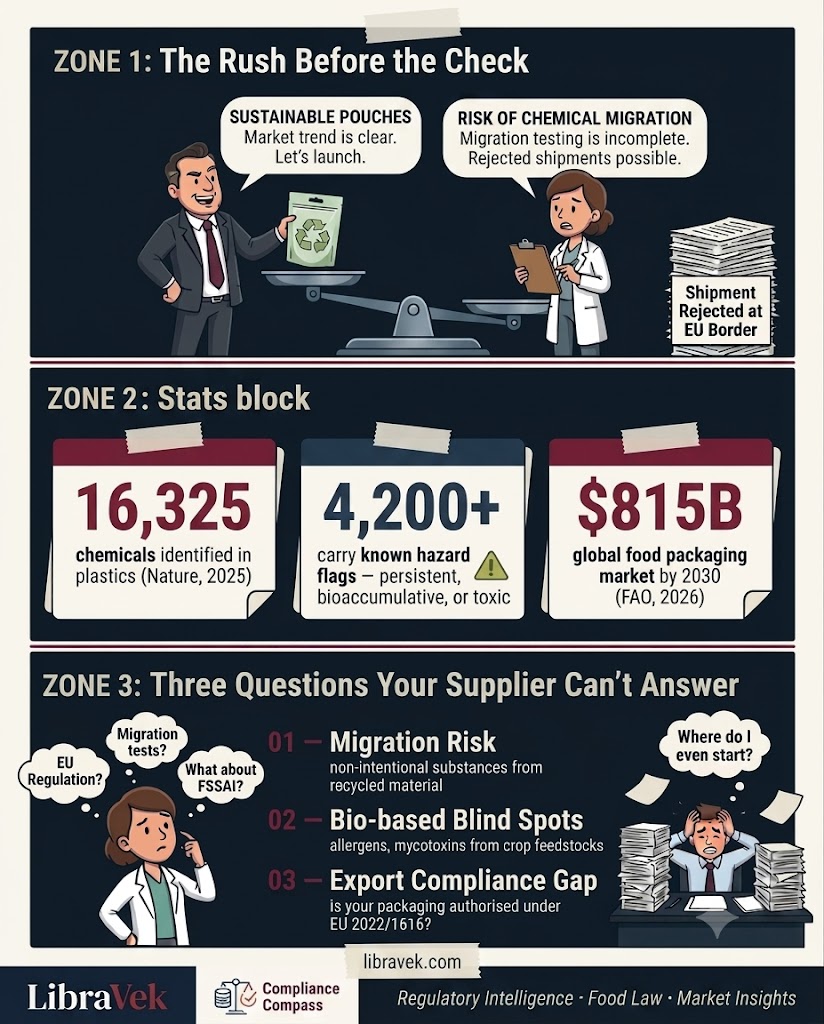
The scale of the chemistry problem is laid out in a parallel Nature study (NTNU, 2025), where over 16,000 chemicals globally have been identified in plastic packaging, whether intentionally used or not. More than 4,200 of these carry known hazard flags: persistent, bio-accumulative, or toxic to human health. In addition, recycled plastic releases higher quantities of harmful non-intentionally added substances (NIAS) including heavy metals, brominated flame retardants, phthalates, and persistent organic pollutants compared to virgin materials.
Most businesses switching to recyclable packaging have never asked a single question about what those materials contained in their previous life
It is not only recycled plastics but also most sustainable claimed packaging material -"Bio-based package", derived from plant-fibre like corn trays to compostable pouches and cassava (starch) based films, carries its own category of risk: allergens from protein-based materials, mycotoxins from agricultural feedstocks, pesticide residues from the crop source. The FAO report specifically names these as areas where safety data is thin and regulatory frameworks have not caught up.
Where does India stand?
The FAO report is guidance, not law. But that distinction matters less than most businesses assume. When international bodies like Codex Committee on Contaminants in Foods (CCCF), which has already agreed to prepare a formal discussion paper for its 19th Session in October 2026, specially focused on developing guidance on recycled materials in food packaging. When codex moves toward harmonised global rules, national regulators follow. FSSAI has done this before, and it will do it again.
There is also a concrete export-market gate that is often missed. The EU now approves the plastic recycling process individually under Regulation (EU) 2022/1616. An Indian exporter using recycled packaging does not simply need a “recycled material” instead they need an authorised recycling process. That is a very different compliance question, and most Indian food businesses have not yet had it.
The businesses that will face disruption are not the ones who ignored sustainability. They are the ones who moved fast on sustainable packaging without building the compliance infrastructure to support it.
A recyclable pouch without a migration safety assessment is not a sustainable choice. It is a liability waiting to be discovered
Packaging Material risk at a glance
| Material type | Key chemical risk | Regulatory exposure |
|---|---|---|
| Recycled plastic | Heavy metals, phthalates, flame retardants, POPs, NIAS from prior consumer use or misuse | EU Regulation 2022/1616 requires individually authorised recycling process; CCCF guidance in development |
| Bio-based / compostable | Allergens (protein-derived), mycotoxins, pesticide residues from crop feedstocks (corn, cassava, sugarcane) | Safety data thin; no harmonised global standard; FSSAI framework not yet updated |
| Nano material-enhanced | Nano-migration pathways not fully characterised; intentionally added for performance or active packaging | FAO flags need for case-by-case safety evaluation; no validated detection methods yet standardised |
Three things your packaging supplier probably cannot tell you:
What non-intentional substances from prior use are migrating from your recycled material into food?
Has your bio-based packaging been tested for allergen migration, especially if it is protein or starch derived?
If regulations tighten in your export markets next year, is your current packaging already compliant, or are you starting from zero?
If none of these have been part of your packaging conversation so far, that is not a criticism. It is simply where most businesses are right now. The question is whether you want to find out the answers before or after a regulator does.
Found this useful? Share it with your network.
Share on LinkedInThis is exactly the work we do.
If something here made you think twice about a label, a claim, or a market you are entering, that is worth a conversation.
Start the conversation