The Real Cost of India's Food Label Isn't the Label. It's Reformulating Twice!
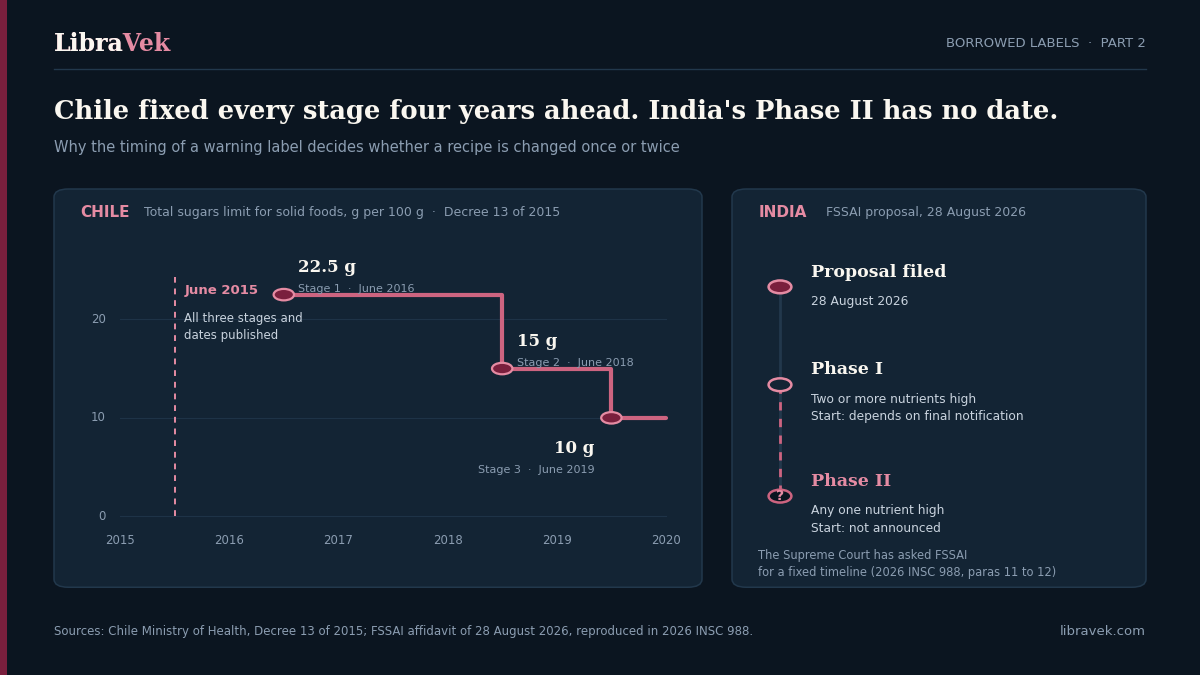
The Supreme Court has asked FSSAI thirteen questions about its proposed warning label. Read as a manufacturer would read them, they come down to eight issues that are still open. A recipe changed to fit today's proposal may have to be changed again.
Where things stand.....
On 10 September the Supreme Court gave FSSAI (the Food Safety and Standards Authority of India, the national food regulator) ten days to answer thirteen questions about its proposed warning label. Those answers were due on 20 September. The Court hears the matter again on 28 September. This piece is written between those two dates. Nothing below assumes what either side will say.
The responses to Part 1 of this series told me something useful. Senior regulatory teams in Indian food companies have already checked their products against the proposed limits. They know which products cross the line today.
The harder question is what happens when the line moves. On my reading of the Court's order, it is likely to move, and not only in one direction.
First, what "Phase I" and "Phase II" mean?
FSSAI's proposal was filed in an affidavit (a sworn written statement submitted to the court) on 28 August 2026. It introduces the warning in two stages.
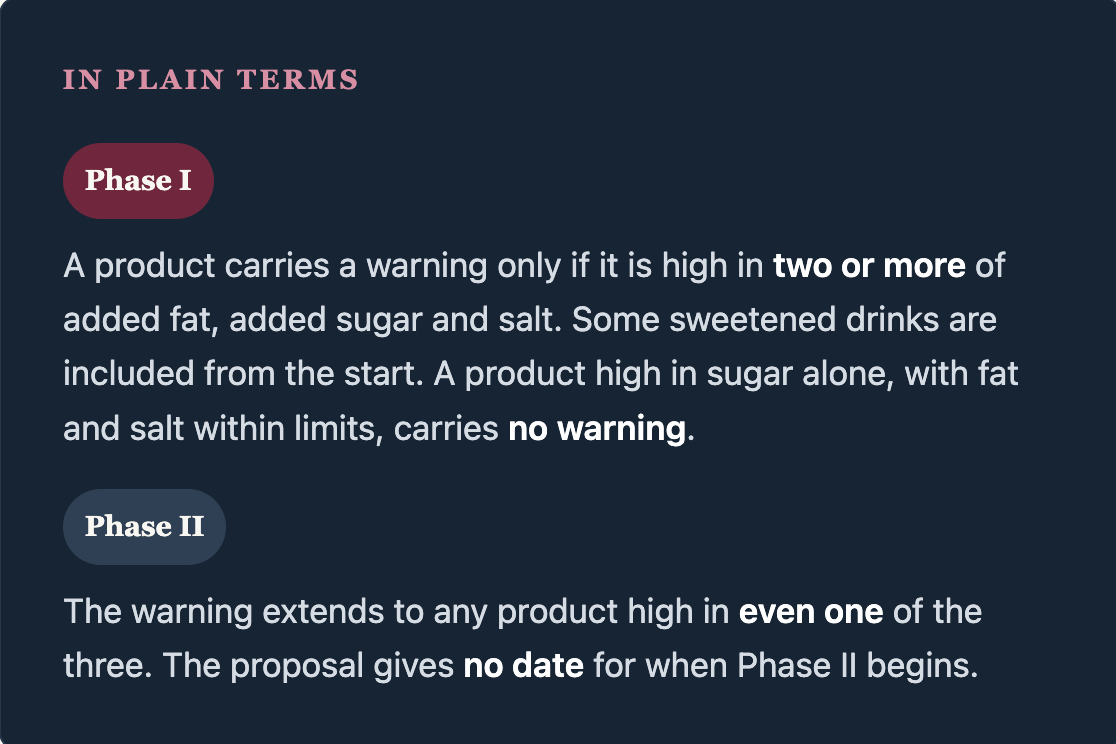
This means a product that stays outside Phase I because it is high in only one nutrient is exempt only for now, since Phase II would bring it under the warning. The Court raised the same concern, observing that without a fixed date Phase II "might take a backseat or be indefinitely postponed", and asked FSSAI to state a clear timeline (paras 11 and 12).
"Not approved yet" means more than people think
There is a second timeline that most commentary has missed. Even after the Court is satisfied, the label does not automatically become law. FSSAI's own affidavit says it "will be notified by way of an amendment in the respective regulations by following prescribed procedure."
In simple terms, that procedure looks like this.
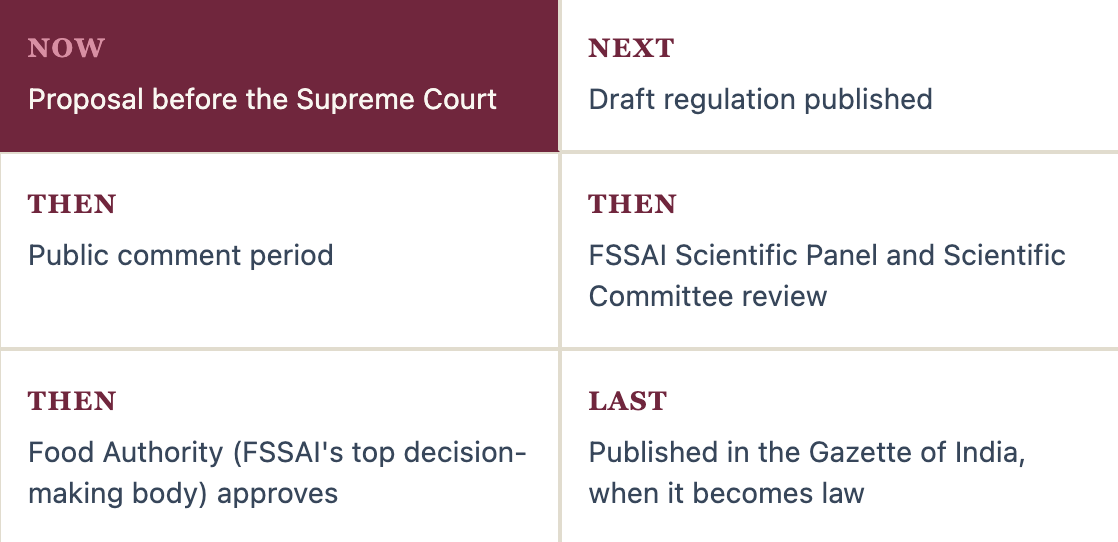
How long can this take? The court record gives a real example. A much simpler labelling change, printing nutrition information in bold letters, was published as a draft on 17 February 2025. Public comments closed on 20 April 2025. It then went through the Scientific Panel and Scientific Committee, and reached the Food Authority on 24 November 2025, where it was deferred. More than nine months after the draft, it was still not final.
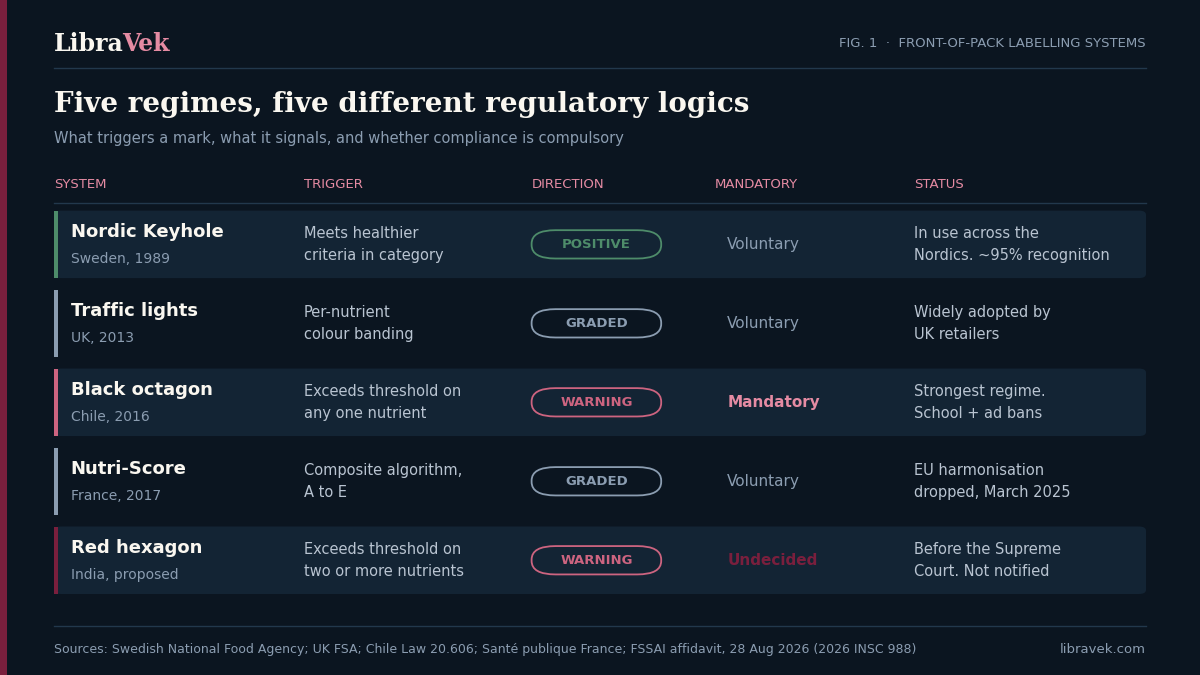
The earlier proposal for a star rating on food packs took longer still. It was published as a draft in September 2022 and received more than 14,000 comments. An expert committee was set up in February 2023. In January 2026, FSSAI told the Court there was "no consensus" among stakeholders on it. The red hexagon has since replaced it.
This does not mean manufacturers can relax. On 13 August the Court said that if the government did not act on its own, "we shall proceed to pass further directions", and that it did "not approve the stance" that India cannot match international standards (order of 13 August 2026, paras 19 and 21). The room for delay is getting smaller. But it does mean the final rule is likely to differ from today's proposal. That gap is the real planning problem.
Eight open issues, and what each one means for a product
In my reading, the thirteen questions reduce to eight issues that matter to a manufacturer. Each one could change whether a product carries a warning, or what that warning looks like.
| Open Issue | Current proposal | Q. | What it could mean? |
|---|---|---|---|
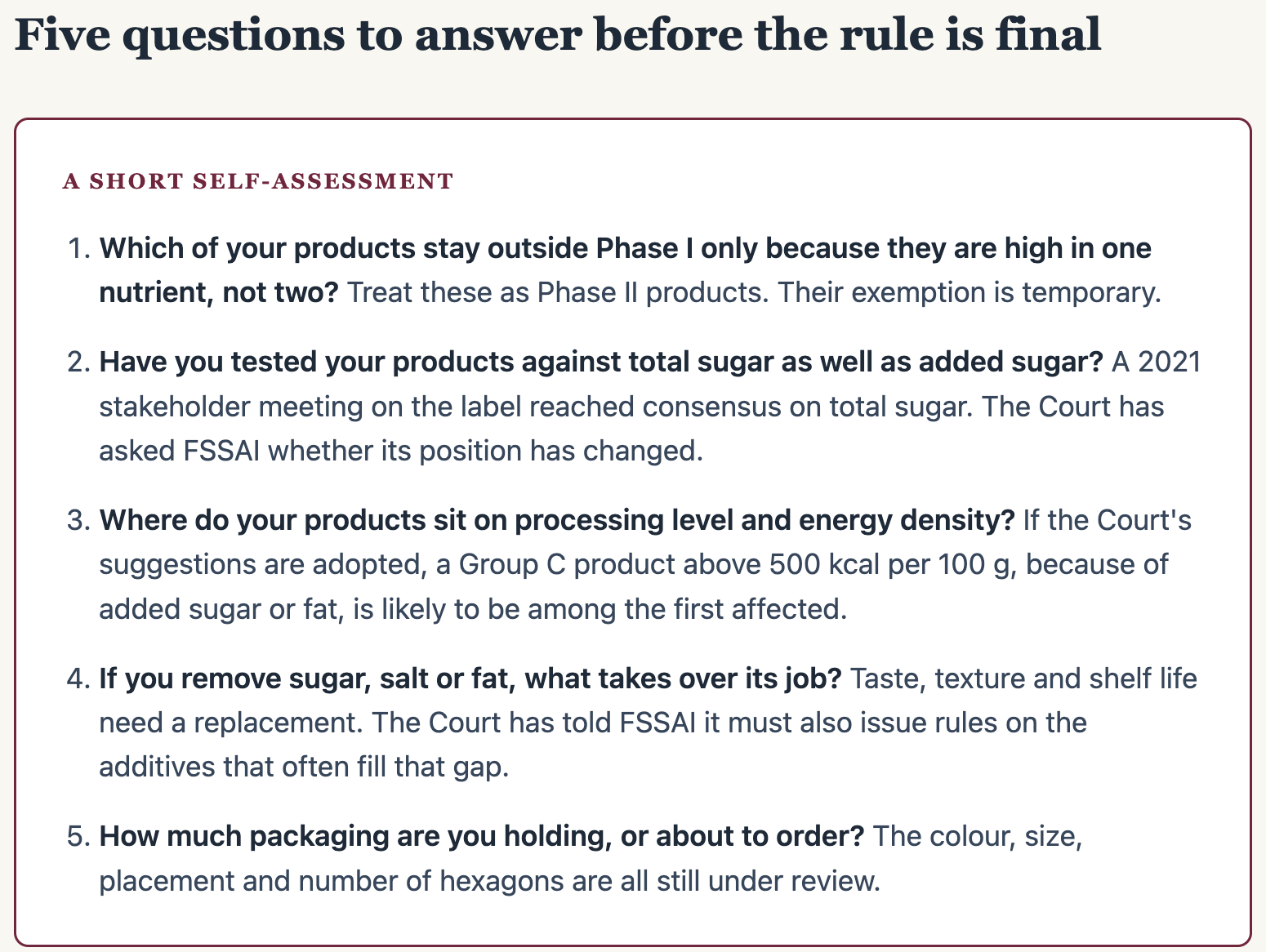
| Trigger | High in two or more nutrients | ii | Products high in only one nutrient may lose their exemption sooner |
| How sugar and fat are measured | Added sugar, added fat | vi | A move to total sugar would also count sugar naturally present in ingredients such as milk or fruit. Trans fat is not yet covered |
| Level of processing | Same limits for all foods | v | Ultra-processed foods could face different limits from minimally processed ones |
| Energy density | Not considered | iv | Foods above 500 kcal per 100 g because of added sugar or fat could be targeted first |
| Drinks | "Specified" sweetened drinks in Phase I | iii | Which drinks, and at what limit, is still not defined |
| Design | One red hexagon, words only | vii to x | Colour, size, placement, pictures and separate hexagons per nutrient are all under review |
| Additives | Not addressed | xi | FSSAI has been told it must also issue rules on additives used as replacements |
| Time to comply | Not stated | xii | The earlier star-rating draft allowed 48 months voluntary. This proposal has not said |
A few terms in that table are worth explaining. "Added sugar" is sugar put into the product during manufacture. "Total sugar" is all the sugar in it, including what is naturally present in milk or fruit. "Trans fat" is the type found mainly in partially hydrogenated oils such as vanaspati and some bakery shortenings. "Ultra-processed" means made largely from industrial ingredients and additives, rather than from recognisable whole foods.
Three of the eight issues deserve a closer look, because they are the most likely to surprise.
Level of processing
he guidelines FSSAI relies on come from ICMR-NIN (the Indian Council of Medical Research's National Institute of Nutrition, which publishes India's official dietary guidelines). They already sort food into three groups by how processed it is. Group C, described as extensively processed and mass produced with additives, includes commercially produced bread, breakfast cereals, cakes, chips, biscuits, fries, jams, sauces and mayonnaise, as well as commercially produced ice cream, and all cool drinks, energy drinks and fruit juices (para 20, Table 15.2). The Court has said that, if feasible, different limits could be set according to how processed a product is (para 26). If that happens, the group a product falls into could matter as much as its nutrient content.
Energy density
The same guidelines separate high-calorie foods into two bands: 250 to 500 kcal per 100 g, and above 500 kcal, in both cases because of excessive added sugar or fat. Foods that are naturally high in energy, such as nuts and seeds, are not counted. The Court suggested one option would be to target the higher band first and then tighten over time, following a model from Israel that the petitioner (3S and Our Health Society, the organisation that brought the case) described (paras 13, 14 and 21 to 23). Under that approach, the first products covered would be the most energy-dense. In my observation, fried snacks and biscuits are among the categories most likely to be near that line. The only reliable check is your own nutrition table.
Design
Almost every visual feature of the hexagon is under question, including whether it should be red at all when red already signals non-vegetarian food in India, how large it should be relative to the pack, where on the pack it must appear, whether each nutrient should have its own hexagon, and whether pictures should be added for people who cannot read the words (paras 31 to 43). My practical advice is to be cautious about printing large packaging runs against today's design, since any of these could change.
The product that clears Phase I by the smallest margin is the one with the least time before Phase II reaches it.
Why reformulating twice is the expensive path
This is the sequence I would try to avoid.
A team reformulates (changes the recipe) now, reducing sugar just enough that only one nutrient remains high, and the product goes to market outside Phase I. Then the trigger changes, or total sugar replaces added sugar, or Phase II begins, and the same product needs a second round of work. That second round usually comes on a shorter timeline, with less room to test taste and consumer response, and possibly under far more public attention than the first.
Chile shows what a staged system looks like when the dates are fixed. Its Ministry of Health published all three stages in a single decree in 2015, a year before the first stage began. Manufacturers could see the final 2019 limits four years in advance.
| NUTRIENT | FROM JUNE 2016 | FROM JUNE 2018 | FROM JUNE 2019 |
|---|---|---|---|
| Energy | 350 kcal | 300 kcal | 275 kcal |
| Sodium | 800 mg | 500 mg | 400 mg |
| Total sugars | 22.5 g | 15 g | 10 g |
| Saturated fat | 6 g | 5 g | 4 g |
Two details in that table matter for India. The sugar limit for solid foods was more than halved over three years. And Chile measures total sugars, not added sugar, which is the same question now before the Indian Court.
In the first year alone, the share of packaged products carrying any warning fell from 51 per cent to 44 per cent as manufacturers changed their recipes (Reyes et al., PLOS Medicine, 2020). In my reading, knowing the final limits in advance allowed companies to plan against the end point rather than the first step. India's proposal does not yet give manufacturers that option.
A case must be noted: what happened to business in chile?
This is the evidence most relevant to a conversation with senior management, and it points in two directions.
Household purchases of drinks carrying a warning fell by 23.7 per cent compared with what would have been expected without the law (Taillie et al., PLOS Medicine, 2020). That is a large shift in what people bought.
Yet across the industry as a whole, the jobs did not disappear. Researchers including economists at Chile's Central Bank, using official tax records, found no effect on total employment or average real wages in food and drink manufacturing 18 months after the law began (Paraje et al., Food Policy, 2021). A report by the UN Food and Agriculture Organization and the University of Chile found the same for jobs, wages and production, and noted that industry complied with the labels and responded by reformulating and launching new products (FAO and INTA, 2021). A follow-up study over three years found only negligible effects on real wages and gross profit margins (Paraje et al., Nutrients, 2022).
My reading of these findings together is that warning labels did not shrink the industry so much as move demand from some products to others. The sector as a whole held steady, while individual products gained or lost ground. For a manufacturer, then, the useful question is not whether the market survives, but which of your products end up on the losing side of that shift.
Well, the competition may not be the other brand...
There is one more piece of evidence that matters here, and it comes from Europe.
I am a co-author on a study with colleagues at the University of Padova, published this year in Food Frontiers. It looked at how Nutri-Score (the A to E front-of-pack label used in France and several other European countries) affects Italian consumers when they plan a whole meal, rather than when they compare two products on a shelf. Once the label was visible, choices changed not only within food categories but across them. Lower-rated cheese products were chosen less often, and plant-based alternatives gained attention.
What I take from this for manufacturers is that when a warning appears across a whole category, making your product slightly better than a competitor's may not protect your sales, because the consumer may move to a different category altogether rather than to a rival brand.
I think this matters even more in India, because Indians do not all buy packaged food in the same way. What follows is my own observation rather than the finding of a study, but I expect most readers will recognise it.
Many older shoppers, and many families outside the large cities, still buy snacks from the neighbourhood kirana shop, where the shopkeeper hands the packet across the counter and there is little opportunity to compare labels at all. In metro cities, a growing number of younger, health-conscious buyers order the same snacks on quick-commerce apps such as Blinkit, Zepto or Swiggy Instamart. There, products from different categories appear side by side on a single screen, and moving from one to another takes a single tap. The same warning label is therefore likely to work very differently in these two settings.
For the app buyer, a warning on a packet of fried chips may not lead to a different brand of chips. It may lead to roasted makhana, peanuts or roasted chana instead. A warning on a cream biscuit may send them towards nuts, and one on a sugary cold drink towards coconut water or buttermilk. It is worth noting that the ICMR-NIN guidelines list whole nuts, coconut water and buttermilk among their examples of minimally processed foods, and chips, biscuits and cool drinks among their examples of ultra-processed ones (para 20, Table 15.2). Not every alternative is automatically healthier, since salted and roasted snacks can still be high in salt or fat, but the direction of the switch is clear.
For a manufacturer, this suggests that protecting market share in metro India may depend less on outperforming a rival brand and more on whether you also have a credible product in the category your customers are moving towards.
Another case worth knowing: What Singapore did differently
Singapore is worth looking at because it is an Asian market, and because it made its dates clear from the start.
The government announced its Nutri-Grade label (an A to D grade based on sugar and saturated fat) for drinks in October 2019. The regulations were published on 30 December 2021. The label became mandatory for pre-packed drinks on 30 December 2022. Manufacturers therefore had a fixed date roughly three years ahead. The Ministry of Health reported that manufacturers had progressively labelled their products, changed recipes and introduced lower-sugar options before that date (Ministry of Health, 29 December 2022).
Three later steps are directly relevant to India.
First, from 30 December 2023, the requirement was extended to freshly prepared drinks, including those listed on digital platforms and online menus. The Indian Supreme Court has also noted that food buying in India "is going digital" and that label design must reflect this (para 38).
Second, in April 2025 the Ministry confirmed that from mid-2027 the label will extend beyond drinks to 23 sub-categories of pre-packed salt, sauces, seasonings, instant noodles and cooking oil. Each sub-category gets its own limits. The Ministry's stated reason is that this encourages reformulation within each sub-category while preserving the diversity of products. The mark must appear on the front of the pack and on online product listings, and it will name the nutrient that caused the grade (Ministry of Health, 6 April 2025). Whether limits should vary by type of food, and whether each nutrient should have its own mark, are both open questions before the Indian Court.
Third, Singapore chose to include cooking oil. India's proposal exempts edible oil, ghee and other single-ingredient products.
Singapore also paired the requirement with practical support: a government grant to help suppliers develop and reformulate healthier ingredients (Ministry of Health, 6 April 2025).
The pattern, as I see it: start with one category, fix the dates, then widen the scope. Manufacturers in India should expect something similar.
The industry's preferred alternative has already been heard
One part of the order has received almost no attention. The All India Food Processors' Association took part in the case as an intervenor (a party allowed to join a case to present its own view). It argued for a different model: stating nutrients per serving as a percentage of Nutrient Reference Values (standard daily reference amounts), as some Western countries do (para 46).
The Court described that model as "scientifically sound and consumer empowering". It said displaying such data "would be helpful". But it concluded that numbers alone "cannot raise a red signal" and may "turn out to be a red herring, likely to be ignored, rather than be noticed". For that reason it found a warning-style label "more appropriate" (para 47).
What this means for planning, in my view: a numbers-only outcome, without a warning, has already been argued and did not persuade the Court. A strategy that depends on it coming back should be reconsidered.
Not everyone starts from the same place...
This is my own observation, not a finding from a study. Multinational companies that sell in Chile, Mexico or other countries with warning labels have usually been through this before. Many will already have adjusted recipes, supplier relationships and consumer research they can adapt for India.
Mid-sized and smaller Indian manufacturers are more likely to be starting from the beginning, with less spare capacity in research, development and packaging. For them, the uncertainty in the current proposal is more costly, because they have fewer chances to get it right.
Concluding remark: What this adds up to
None of this is final. The rule has not been notified, Phase II has no date, and the time allowed for compliance is a question the Court has put to FSSAI directly.
But on my reading, the direction is fairly clear. Most of the Court's questions point toward a more detailed label than the one proposed: separate marks for each nutrient, pictures, larger size, total rather than added sugar, and a fixed date for Phase II. One suggestion, targeting the most energy-dense foods first, could narrow which products are covered at the start. So the final rule may be stricter in some ways and more targeted in others. What it is unlikely to be is the proposal exactly as written.
A more useful approach is to check products against the range of likely outcomes rather than the current draft alone, and decide which ones need attention first.
Found this useful? Share it with your network.
Share on LinkedInSupporting sentence under the CTA heading
That gap is the real cost of this label, and mapping it now, before the rule is final, is the work we do at LibraVek.
Start the conversationRelated topics

Disclaimer: this post provides general strategic and regulatory intelligence for informational purposes only. It does not constitute formal legal or certified compliance advice, nor does it establish a formal advisory relationship. Food regulations change rapidly across jurisdictions; do not act on this information without seeking tailored professional counsel. LibraVek disclaims all liability for actions taken based on this content. Sources: Supreme Court of India, 3S and Our Health Society v. Union of India, M.A. No. 1177 of 2025 in W.P.(C) No. 437 of 2024: order of 10 September 2026 (neutral citation 2026 INSC 988), which reproduces FSSAI's affidavit of 28 August 2026 and the order of 13 August 2026; order of 10 February 2026. ICMR-National Institute of Nutrition, Dietary Guidelines for Indians (2024), Guideline 15, Tables 15.1 and 15.2. nin.res.in Ministry of Health of Chile, Decree No. 13 of 2015 amending the Food Sanitary Regulation (Decree 977 of 1996), published 26 June 2015. Singapore Ministry of Health: announcement of Nutri-Grade regulations; rollout, 29 December 2022; freshly prepared beverages, December 2023; sodium and saturated fat, 6 April 2025. Corvalán C., Correa T., Reyes M., Paraje G. (2021). The impact of the Chilean law on food labelling on the food production sector. Santiago: FAO and INTA, University of Chile. doi.org/10.4060/cb3298en Reyes M. et al. (2020). Changes in the amount of nutrient of packaged foods and beverages after the initial implementation of the Chilean Law of Food Labelling and Advertising. PLOS Medicine 17(7): e1003220. Taillie L.S. et al. (2020). An evaluation of Chile's Law of Food Labeling and Advertising on sugar-sweetened beverage purchases from 2015 to 2017. PLOS Medicine 17(2): e1003015. Taillie L.S. et al. (2024). Decreases in purchases of energy, sodium, sugar, and saturated fat 3 years after implementation of the Chilean food labeling and marketing law. PLOS Medicine. Paraje G., Colchero A., Wlasiuk J.M., Sota A.M., Popkin B.M. (2021). The effects of the Chilean food policy package on aggregate employment and real wages. Food Policy 100: 102016. Paraje G., Montes de Oca D., Wlasiuk J.M., Canales M., Popkin B.M. (2022). Front-of-Pack Labeling in Chile: Effects on Employment, Real Wages, and Firms' Profits after Three Years of Its Implementation. Nutrients 14(2): 295. Stiletto A., Cei L., Singh A., Trestini S. (2026). Unpacking the Impact of Nutri-Score on Consumer Choices in Italy: Evidence From a Menu Planning Experiment. Food Frontiers.