Dear, Indian Food Business: Clearing the EU Border is not the end. RASFF Tells the Rest !
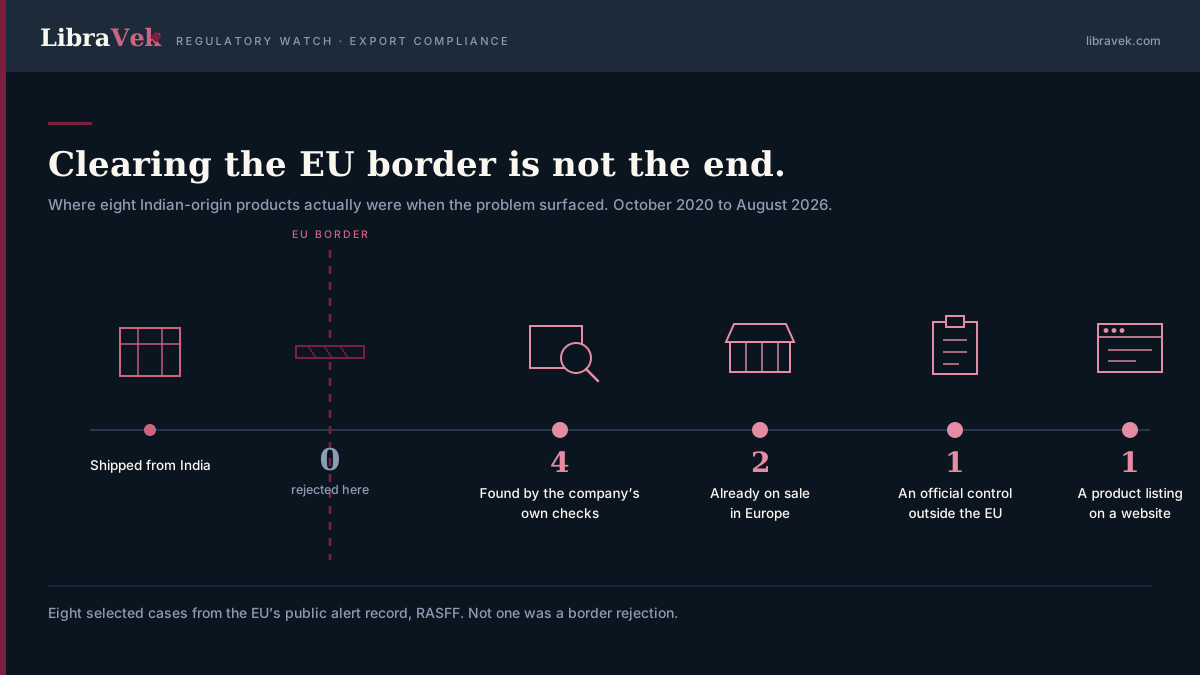
Eight cases from the EU's public alert record, October 2020 to August 2026. Not one was a border rejection.
Imagine a scenario, somebody in Belgium was looking at what was being sold online !
Not a lab, not a port, not an inspector opening a container in Belgium.
But, a government official, at a desk, clicking through web shops the way any of us might on a slow afternoon. They found one selling food supplements from India. The website listed the ingredients. Two of them, yohimbine and ephedra, are not allowed in food supplements anywhere in Europe. The site did not appear to ask for a doctor's prescription at checkout.
Nobody ordered a sample, Nobody sent anything to the laboratory.
The official record says it plainly: no analysis was done.
It went into Europe's food safety alert system, recorded as a serious risk.
European officials were still following it up six months later.
Well, his is a real notified case in June 2023, and you can read it yourself, because Europe publishes all of this. The record is called RASFF, short for the Rapid Alert System for Food and Feed. It is free, it is public, and it has been sitting there the whole time.
We went through it and picked eight cases involving food from India, spread across October 2020 to August 2026. Not one of them was a shipment stopped at the border. Four were found by companies during their own testing. Two by government inspectors checking products already on sale in European shops. One by an inspection outside Europe. And one, this one, by somebody looking at a website.
What is RASFF?
Think of it as a shared noticeboard for food safety.
Every European country has its own food safety authority. When one of them finds a problem with a food product, it posts the details on this shared system. Every other country sees it the same day. A problem found in Denmark on Tuesday is known in Poland and Italy on Tuesday, not next year.
The problem can surface in many ways. A government inspection. A company's own testing. A customer complaint. Or someone in Belgium watching what is being sold online.
The system covers the 27 EU countries, plus Norway, Iceland, Liechtenstein and Switzerland. The United Kingdom took part for decades but is no longer in it after Brexit.
Three things to understand before you look at it:
1. There is more than one kind of entry
Some entries record a shipment refused at the border. Some record a serious problem found in a product already being sold. Others record problems other countries should know about but do not need to act on urgently. These mean very different things. Treating them all as "rejections" is the most common mistake people make with this data.
2. It is not a blacklist
An entry records one problem found at one moment. It is not a judgment on your company, and the public version usually does not name the company or the brand.
3. It is free and open to everyone
Searchable by product, by country, by year, going back to 2020. Your European buyer can search for it. So can your competitor.
Eight cases, and what each one teaches
How we chose them: we looked through entries involving food from India and picked eight, spread over six years, to show different kinds of problems. These are examples, not a full count. There are considerably more entries than eight.
| Product | Notified | what the record shows | what it teaches |
|---|---|---|---|
| Sesame seed | Oct 2020 | Ethylene oxide, far above the limit stated in the notification | A treatment done before shipping becomes your problem in Europe |
| Curry powder, used in a French-made cereal premix | Sep 2021 | Ethylene oxide residue | Your ingredient carries your risk into someone else's product |
| Food supplements on a web shop | Jun 2023 | Banned ingredients, identified from the website. No analysis was done | What your website says is part of what gets checked |
| Chips | Jan 2024 | Capsaicinoid levels recorded as too high, plus labelling deficiencies | Recipe and label are assessed together, not separately |
| Prawn chutney powder | Jul 2024 | Crustaceans incorrectly declared | A label mistake alone can trigger a recall |
| A semi-finished supplement ingredient | Sep 2024 | Suspected bacterial contamination | Ingredients carry risk into every product they enter |
| Organic chilli | Apr 2025 | Aflatoxin above limit | Organic certification is not a food safety guarantee |
| A laxative food supplement | Aug 2026 | Two prohibited plant compounds | Ingredient legality changes from country to country |
Look at that list again. A laxative supplement, a packet of chips and a French breakfast cereal have nothing in common as products. As compliance failures, they have everything in common.
Four ways this goes wrong
The same substance, two very different lessons
Two of these cases involve ethylene oxide. It is a gas used to kill bacteria and mould on dried spices before packing. It works, it is cheap, and it is widely used.
In the United States, it is officially approved for exactly this purpose. In Europe, it is not approved at all, and the amount allowed to remain on the food is close to what a laboratory can even measure.
Same gas, same spice but opposite answers, depending on where you ship.
But the two cases teach different things. In the first, the gas was found on sesame seeds, tested as sesame seeds.
In the second, it was found in curry powder that had already been mixed into a breakfast cereal made in France and sold under a French brand. Nothing on the front of that box pointed back to India.
If you sell ingredients rather than finished products, that second case is the one to sit with. Your risk does not end when your goods leave your hands. It travels into somebody else's recipe, and it appears there, under their name, in their recall.
Something natural that grew past the limit
Aflatoxin is a poison produced by certain molds. Nobody adds it. It grows during drying and storage, especially in humid weather.
In the chilli case, the product was certified organic. That did not help. Organic certification describes how a crop was grown. It says nothing about what happened to it while drying in monsoon humidity. Two completely different questions, and two completely different tests.
Something true that was never written on the label
The prawn chutney case involved no contamination at all. Shellfish, a major allergen, was not properly declared on the label. That alone caused a public recall notice in Ireland.
The chips case combined a recipe problem with label errors, and the product was banned from sale in Germany.
In the first of those, nothing unsafe was present in the product. The declaration was the entire problem.
Something your own website said
Which brings us back to Belgium.
European officials do not only see the product inside your container. They can also see what you say is in it, and how you sell it to European customers.
For a supplement brand, the check extends past the physical product and into your online shop. Your website is doing more work than you think, and not all of it is marketing.
Three questions worth asking before your next shipment
Which method does your processor actually use to sterilise?
Not what you assume, and not what was agreed three years ago. This step often happens at a third-party facility, and the answer decides whether a market is open or closed to you. Two of the eight cases above come down to this single question. Get the answer in writing.
Where does your ingredient end up after you sell it?
If you supply manufacturers rather than consumers, your material becomes part of products you never see, in countries you never shipped to directly. A problem found two steps downstream still traces back to your batch, and you will hear about it last.
What do your label and website say that your lab report does not cover?
Allergen declarations, ingredient names, health claims, and whether a plant ingredient even needs permission before it can be sold in Europe. In two of the eight cases above, nothing unsafe was found in the product itself. The words were the problem.
Concluding Remarks
Reading this record as a scoreboard of who failed is a waste of it.
Read properly, it is a map of where things break. And those breaks are not all the same kind of problem. Leftover chemicals, natural moulds, missing allergen labels, banned ingredients and website claims are five different problems needing five different solutions. Most of them have to be solved before your shipment ever leaves India.
So the useful question is not whether your product has ever appeared in this record.
It is whether the reason it could appear is already sitting somewhere in your supply chain, waiting for somebody in Belgium to have a slow afternoon.
Found this useful? Share it with your network.
Share on LinkedInThis is exactly the work we do.
If something here made you think twice about a label, a claim, or a market you are entering, that is worth a conversation.
Start the conversation