Green Tea: Booming in India, Restricted in Europe
India is one of the world's largest producers and exporters of green tea extract. That is a genuinely impressive industry story. Here is the part most Indian food professionals in the category have not read.
Walk into any pharmacy or open any D2C wellness brand and you will find it. The label may say green tea extract, it may say EGCG, it may say Camellia sinensis. It is the same ingredient, and Indian companies have built serious supply chains around it: weight-management capsules, metabolism boosters, antioxidant blends, and increasingly supplements marketed alongside GLP-1 support claims.
What exactly did the European Commission restrict in 2022, and does your product, your label, or your export ingredient fall inside that line?
Let us be precise
This is not about green tea drinks. Not matcha. Not the tea bag in your morning cup.
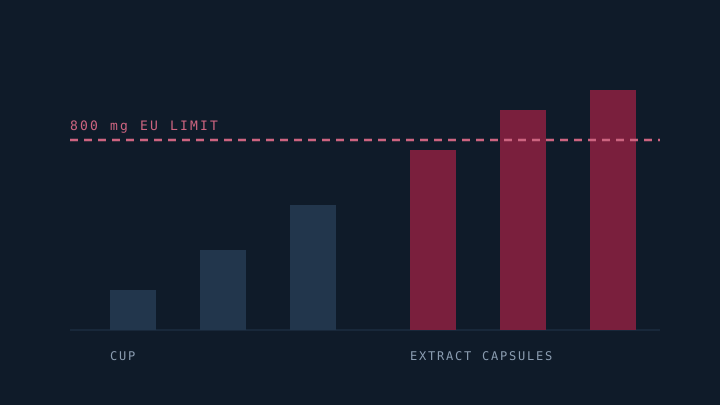
When you brew a cup, you consume a dilute infusion. The compound that gives green tea its health reputation is EGCG, epigallocatechin-3-gallate, and it is the reason the supplement industry built a whole weight-management category around the leaf. In a normal cup you get somewhere between 90 and 150 mg of it. Three cups a day might reach 300 mg. European regulators looked at that level and called it generally safe.
Now consider what happens when the same leaf is processed differently. Extract concentrates the active compounds into a form that goes into capsules, tablets, and health drinks. A single capsule sold in India today can contain 200 to 300 mg of EGCG. Two or three a day, which many products recommend, can take a consumer past 600 mg, and in some formulations past 800.
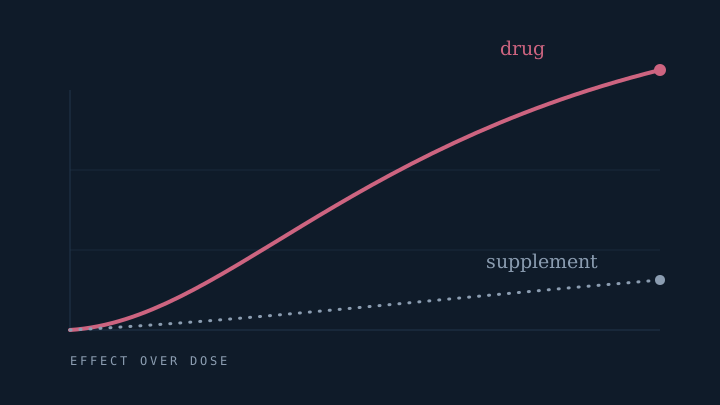
That is not the same thing as drinking tea. The European Commission drew a hard scientific line: not a ban, but a restriction with conditions, and the conditions matter enormously.
The number that changes everything
At 800 mg of EGCG per day from concentrated extracts, European food-safety regulators found measurable liver-stress markers in clinical-trial participants. The Commission responded by restricting products at or above 800 mg per daily portion, placing all green tea extracts under ongoing scrutiny, and requiring mandatory warning labels for products sold in Europe.
Three warnings now mandatory in Europe
Check whether your label carries any of them.
Do not take on an empty stomach
Taking green tea extract while fasting significantly increases EGCG absorption and its toxic potential. This is now a mandatory labelling requirement in Europe. Most Indian supplement labels are silent on it.
Not for pregnant or breastfeeding women
No safety data exists for this group, and European rules require explicit warnings. Check your Indian product label.
Not suitable for anyone under 18
No clinical evidence of safety for minors, so European regulation requires the warning. It is absent from most Indian nutraceutical labels.
Health claims: India and Europe are in genuinely different places
In India, FSSAI recognises nutraceuticals as a legal category. Green tea catechins including EGCG are listed as a permitted nutraceutical ingredient, and a brand can make health claims if they are scientifically substantiated and FSSAI-approved. The framework exists, it is evolving, and Indian brands have navigated it successfully.
In Europe, a health claim is not a marketing decision. It is a formal authorisation, evaluated by the European Food Safety Authority, approved by the Commission, and listed in a public register. If a claim is not on that list, it cannot appear on the label. The weight-management claim for green tea was reviewed, rejected, and removed.
The same product, same capsule, same EGCG content, can carry a weight-management claim in India and cannot carry it in Europe. That gap is not a loophole. It is a compliance risk the moment you cross a border.
Why ingredient exporters should read this twice
India is one of the largest producers of green tea extract for global supply chains. If you sell to European food or supplement manufacturers, your buyers now operate under these restrictions. They need EGCG content clearly specified per batch, documentation that the ingredient meets European conditions, and answers to questions their Indian suppliers may not yet be prepared to give. The implication of a European restriction does not stop at the European brand. It travels back to the ingredient source.
The honest summary
| Category | India (FSSAI) | Europe (2022) |
|---|---|---|
| EGCG extract permitted? | Yes | Yes, with conditions |
| Weight-management claim? | Allowed (FSSAI) | Rejected |
| Dose cap? | Not specified | 800 mg hard limit |
| Fasting warning required? | Not specified | Mandatory |
| Pregnancy / child warning? | Not specified | Mandatory |
| Under regulatory scrutiny? | Evolving | Yes, all extracts |
What should you do with this?
If you are a nutraceutical startup, decide which markets you want to enter before you finalise formulation and label, because each market will ask different things of your product. If you are a supplement brand, check your EGCG content per daily dose and check what your label does and does not say; what is acceptable in India may not be acceptable in the EU. If you are an ingredient exporter, your European buyers already know this regulation, and being the supplier who can speak to it fluently is a commercial advantage.
The 2022 action is not a story about tea being dangerous. It is a story about how health claims, dosage science, and regulatory frameworks can look completely different depending on which market you are in, and how that difference has real consequences for your business.
Found this useful? Share it with your network.
Share on LinkedInWe read science, markets, and regulation of the food system so our clients do not have to.
We translate changing food trends and laws into decisions that protect what you have built. If something here made you think twice about a label, a claim, or a market you are entering, that is probably worth a conversation.
Start the conversationRelated topics
Regulatory context: European Commission restriction on green tea catechins (EGCG), 2022; FSSAI nutraceutical framework under the FSS Act 2006. This post is for general awareness only and does not constitute regulatory or legal advice.