GLP-1 Booster Supplements: Real Science or Borrowed Hype?
Your feed says Ozempic. That new brand says GLP-1 Booster, 100% natural, no prescription needed. For a manufacturer or food business operator in India, that raises a question the market will not answer straight.
Is a GLP-1 booster supplement the same as a GLP-1 drug? If not, what is it made of, how does it work, and can you legally sell it in India?
These are not simple questions. The market, the advertisements, and most ingredient suppliers will not give you a straight answer. So here is one.
Global regulators are already watching this space. If the pattern abroad holds, India is not immune. It is the next market in line.
In 2025, the European Medicines Agency and the Heads of Medicines Agencies warned of a sharp rise in illegal GLP-1 medicines sold online across the EU. Many products carried fake endorsements, misused official authority logos, and were promoted on social media as effortless weight-loss solutions requiring no prescription. Laboratory analysis found products containing no real active ingredient at all; others contained harmful undisclosed substances at dangerous levels. Authorities identified hundreds of fake profiles, fraudulent listings, and spoofed websites, many hosted outside the EU to evade enforcement.
The hormone and the drug are not the same story
GLP-1, glucagon-like peptide-1, is a hormone your body already makes. It is secreted by L-cells in the gut wall after you eat. Its job is to signal the pancreas to release insulin, slow gastric emptying, and tell the brain you are full. It is a natural, short-lived satiety signal that every healthy body produces, and it is broken down within minutes.
Pharmaceutical GLP-1 drugs such as semaglutide are not that. They are synthetic GLP-1 receptor agonists: engineered molecules designed to mimic and amplify the natural hormone, but with a far longer half-life. Semaglutide stays active for roughly one week after a single injection.
A plant-based supplement cannot replicate the pharmacological action of a GLP-1 receptor agonist. What it can do, through specific mechanisms, is support the conditions under which your body produces and responds to its own natural GLP-1. That distinction is the regulatory foundation of every claim you are permitted to make.
The ingredient science: what actually has evidence?
Several plant-derived ingredients in GLP-1-branded supplements do have peer-reviewed research supporting their interaction with the pathway. The mechanisms differ by ingredient, and the evidence strength varies considerably.
| Ingredient | How it interacts with the GLP-1 pathway | Evidence |
|---|---|---|
| Berberine | Stimulates GLP-1 secretion in intestinal L-cells by modulating gut microbiota and increasing short-chain fatty acid production; also upregulates GLP-1 receptor expression in the ileum. | Preclinical + limited clinical |
| Inulin | Fermented by gut bacteria into SCFAs that bind GPR43/GPR41 receptors on L-cells, stimulating GLP-1 and PYY; also delays gastric emptying. | Preclinical + some human data |
| Curcumin | May enhance GLP-1 secretion and receptor sensitivity; stronger evidence in combination with berberine than alone. | Primarily preclinical |
| Psyllium husk | Viscous fibre that slows gastric emptying and glucose absorption, supporting conditions for natural post-meal GLP-1. | Human evidence for satiety |
| Green tea (EGCG) | Some evidence for enhancing incretin activity and metabolic rate; weaker and more indirect. | Weak / indirect |
| Gymnema sylvestre | Ayurvedic herb with evidence for improving insulin sensitivity and reducing sugar absorption; GLP-1 link is indirect. | Indirect support |
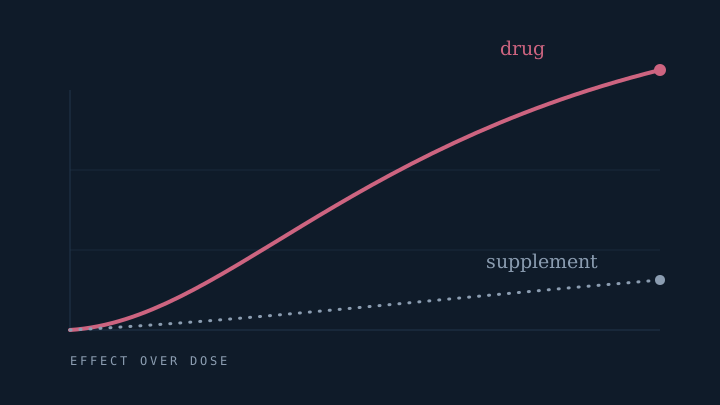
An important fact: most human trials in this space are small, short, and not designed to measure weight loss as a primary endpoint. Berberine, the most studied ingredient, produces modest reductions of roughly 2 to 4 kilograms. That is a very different magnitude from the 10 to 15 percent body-weight reduction documented with pharmaceutical GLP-1 drugs.
The comparison every manufacturer must internalise
| Pharmaceutical GLP-1 drug | Plant-based GLP-1 booster |
|---|---|
| Synthetic GLP-1 receptor agonist | Supports natural GLP-1 secretion via the gut-microbiome pathway |
| Active for up to 7 days per dose | Works transiently through fibre fermentation or cellular signalling |
| 10 to 15% body-weight reduction in trials | 2 to 4 kg modest reduction at best (berberine) |
| Requires prescription and medical supervision | Sold as a food supplement under FSSAI regulations |
| Approved drug under CDSCO / Drugs and Cosmetics Act | Health supplement under FSS Act 2006 and 2016 Regulations |
| Claims: treatment of obesity, type 2 diabetes | Permitted claims: supports satiety, supports healthy metabolism |
Where the regulatory gap sits, and why it matters for your label
India currently has no specific FSSAI guidance defining or restricting the term GLP-1 on a food supplement label. Many manufacturers are reading that silence as permission. It is not.
Under the FSS Act 2006 and the Health Supplements and Nutraceuticals Regulations 2016, a health supplement cannot be represented for use in the diagnosis, cure, mitigation, treatment, or prevention of any disease or disorder. It must carry the mandatory declaration: not for medicinal use.
You cannot use the word Ozempic, semaglutide, or any prescription drug name
Even as a comparison. Phrases like natural Ozempic or Ozempic-like results imply therapeutic equivalence to a prescription drug. This category of claim has been flagged as misleading promotion.
You cannot claim GLP-1 activation as a therapeutic outcome
You may be able to describe a supported functional mechanism, such as supports gut microbiome health or contributes to satiety, if it is backed by ingredient-specific evidence and within FSSAI permitted claim categories.
Your ingredients must be from FSSAI-approved schedules
Berberine, inulin, psyllium, gymnema, and curcumin all have FSSAI-relevant status, but dosage limits, source requirements, and claim linkage must be verified specifically. EU or US approvals are not automatically recognised.
Your substantiation must be defensible
Not merely a study that mentions GLP-1, but evidence that supports the function claimed, at the dose used, in the population targeted. Most generic ingredient studies do not satisfy this on their own.
The gap in Indian regulation is not a green light. It is an unresolved grey zone, and grey zones in food regulation do not protect the manufacturer. They protect the regulator's future discretion to act.
What a compliant, science-backed product actually looks like
It starts with a formulation rationale: a documented scientific basis for why each ingredient is included, at what dose, and what function it supports. It continues with claim mapping: cross-referencing permitted claim categories against the evidence for each ingredient. It ends with a label that communicates a genuine benefit without borrowing the language of prescription medicine.
Done properly, this is a compelling and commercially viable product. The demand is real, the science has a foundation, and the regulatory path exists. Done carelessly, it is a product waiting for a notice.
Found this useful? Share it with your network.
Share on LinkedInThis is exactly the work we do.
Formulation strategy grounded in science. Claim mapping within FSSAI's current framework. Label review that holds up to scrutiny. If you are entering or expanding in the GLP-1 supplement category in India and you want to do it right, start the conversation now.
Start the conversationRelated topics

Regulatory context: FSS Act 2006 and the Health Supplements and Nutraceuticals Regulations 2016; EMA and HMA advisory, September 2025. This post is for general awareness only and does not constitute regulatory or legal advice.